🥉Beautiful fabrics sometimes suggest which patchwork block to choose.

Sometimes the fabric you come across is such that your hand simply cannot bring itself to cut it.
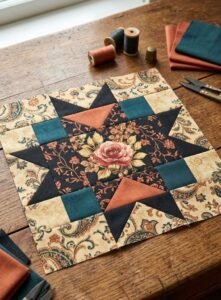
I was recently sorting through my supplies and pulled out a piece of fabric with large roses on a warm cream background.
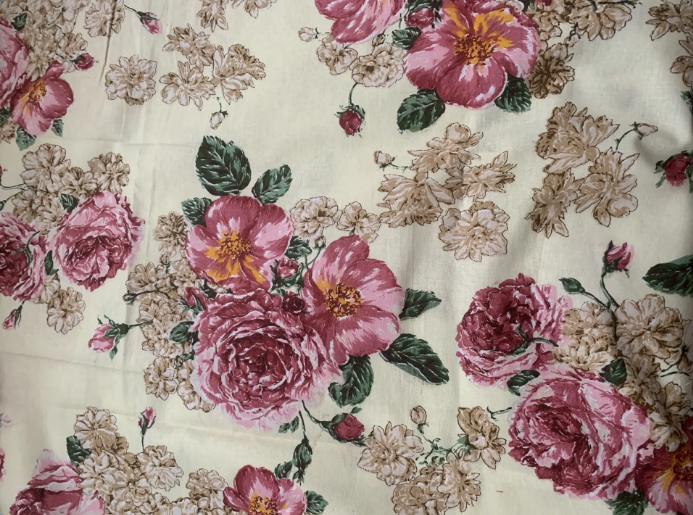
I once bought it simply because I couldn’t pass it by.
And then a problem familiar to many needlewomen arose.
I want to use beautiful fabric, but I’m afraid to ruin it.
Just imagine scissors, and doubts immediately arise: what if the pattern gets lost? What if the fabric looks worse than before?
Probably almost every craftswoman has encountered this feeling at least once.
I was sure that for such a fabric I needed to choose the most beautiful and complex block.
But the longer I looked at this piece, the more I realized something unexpected.
Maybe…
Beautiful fabric doesn’t need a complicated pattern at all.
Not every fabric likes fine cutting
I thought that the beautiful print would withstand any cutting.
In fact, it’s the other way around.
The larger the design, the easier it is to accidentally lose its character.
Large flowers, bouquets, birds, beautiful landscape prints, vintage roses, Provencal-style fabrics—all of this was created specifically for the purpose of admiring the design.
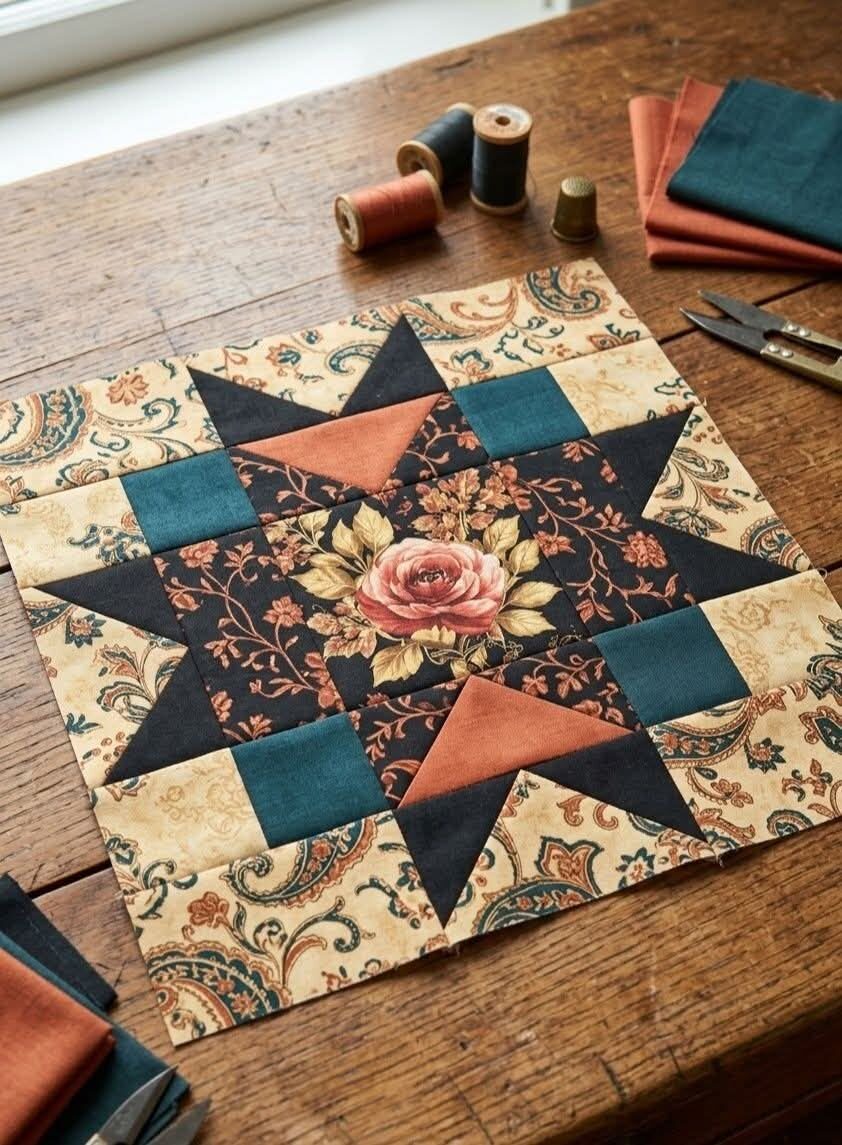
If such a print is cut into dozens of small pieces, you can suddenly lose the most important thing – its character.
Sometimes all that remains of a beautiful bouquet is a fragment of a petal. And instead of a delicate composition, you end up with just a collection of colorful spots.
Therefore, the first question you should ask yourself is not the one you want to ask yourself, but the fabric:
Should it become part of the pattern or the main decoration of the future blanket?
The choice of block depends on the answer.
When is it better to choose simple squares?
It was then that I suddenly understood why experienced craftswomen love ordinary squares so much .
Many people underestimate the square due to its simplicity. However, this very simplicity makes it ideal for fabrics with large patterns.
It allows you to preserve the pattern almost completely and does not fragment the composition.
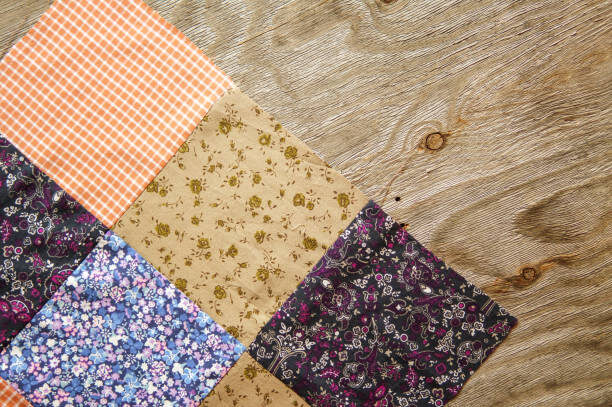
Squares of 15–25 cm work especially well. The pattern has time to unfold, and the blanket doesn’t look overloaded.
For fabric with roses, this is one of the most successful options.
The bouquets remain recognizable, the eye moves calmly from one motif to another, and the fabric continues to tell its story.
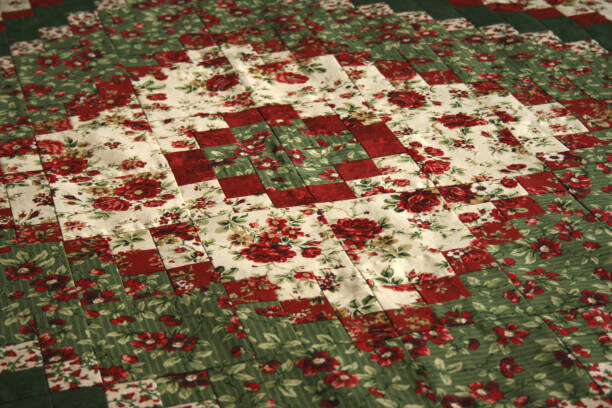
Sometimes the simplest block turns out to be the noblest.
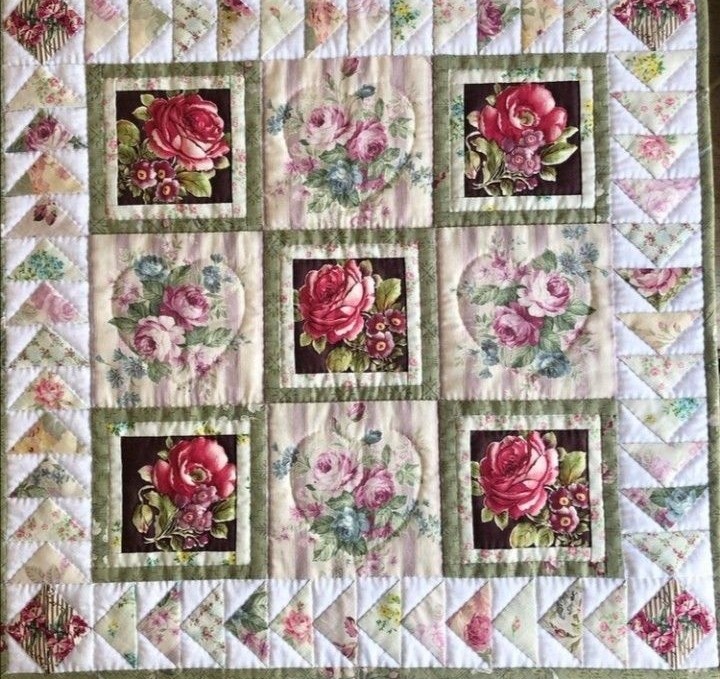
Framed blocks help display fabric
There is another option that often helps when working with beautiful prints.
These are various blocks with frames.
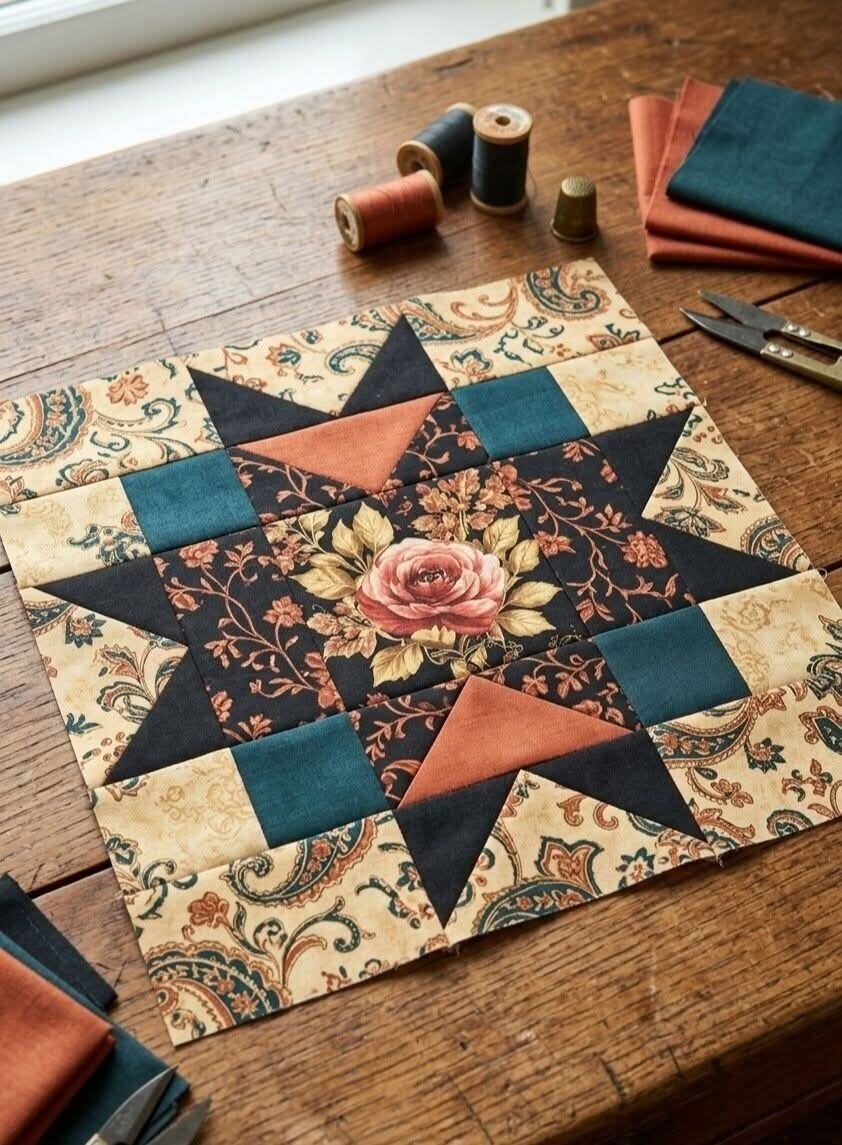
A large piece of fabric is placed in the center, and companion stripes are added around it.
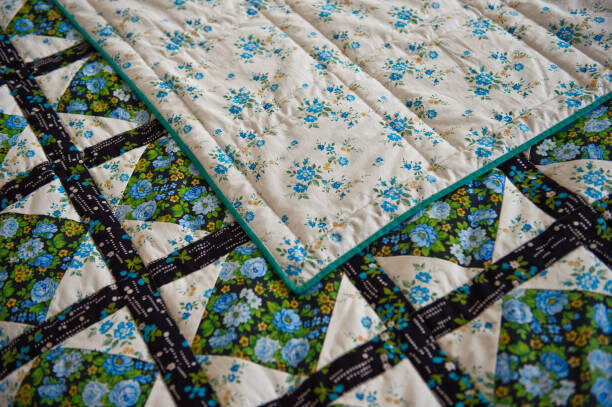
This creates a kind of frame for the drawing.
This approach is good for several reasons:
-
large print is preserved;
-
a patchwork structure appears;
-
the blanket looks more collected;
-
You can use leftovers of suitable fabrics.
In essence, each rose or bouquet turns into a small painting.
If you want dynamics, corners and triangles will do.
Sometimes you want something more interesting than ordinary squares, but you don’t want to cut the fabric too much.
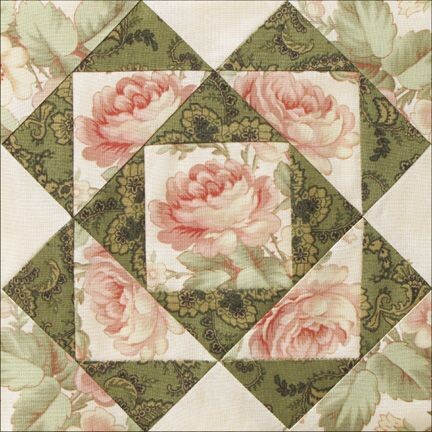
Then it is worth paying attention to blocks where the central square remains large, and the pattern is created through small triangles in the corners.
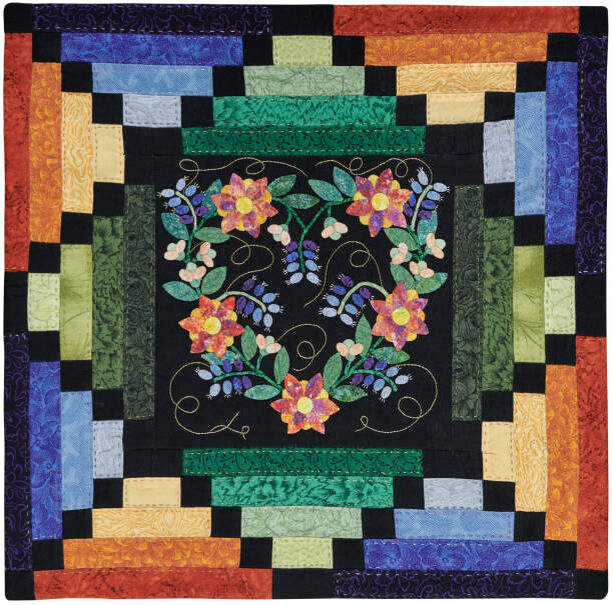
These blocks look more complex than they actually are.
The fabric remains the main element of the composition, but movement and rhythm appear.
It’s a good compromise between classic patchwork and the desire to preserve the pattern.
Sometimes the fabric itself suggests a solution
The longer I do handicrafts, the more often I notice interesting things.
It is not always necessary to match the fabric to the block you like.
Sometimes it’s worth stopping and taking a closer look at the cut itself.
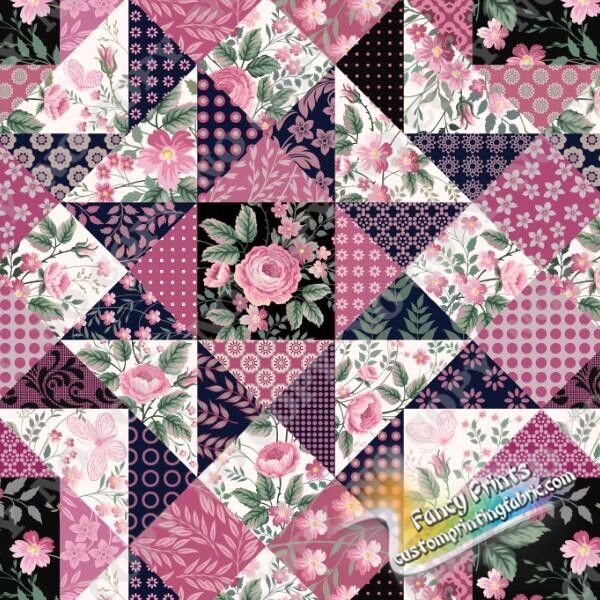
Sometimes it seems like the fabric itself tells you which path to choose.
-
Complex stars will do for one.
-
The other is geometric compositions.
-
And for the third one, a few large squares and a neat binding along the edge are enough.
And perhaps the most successful block for a beautiful fabric is not the most difficult one.
And the one that allows you to preserve its beauty.
Because sometimes the point of patchwork isn’t to hide the fabric inside the pattern.